

Enrolling in an Affordable Care Act (ACA) marketplace health plan often feels like a rare financial victory. You input your estimated household income into HealthCare.gov or your state exchange, and the portal displays an Advance Premium Tax Credit (APTC) that reduces an $850 monthly premium to an affordable $45. For an entire plan year, your healthcare costs feel manageable.
Fourteen months later, tax season arrives. When your certified public accountant prepares your federal tax return, you receive an unexpected financial blow: You owe the Internal Revenue Service $3,800 in Excess Advance Premium Tax Credit Repayment. A year-end holiday bonus, a freelance side-gig, an unexpected capital gains distribution, or an unplanned early retirement withdrawal pushed your annual income past an administrative benchmark, triggering a severe statutory clawback.
This scenario is hypothetical, but the situation is common among independent contractors, small-business owners, and early retirees whose income is hard to predict. The ACA premium subsidy program is not a simple discount—it is an advance federal tax credit governed by the Internal Revenue Code (26 U.S.C. § 36B). Understanding how your income aligns with the Federal Poverty Level (FPL), identifying high-leverage Cost-Sharing Reductions (CSR), and proactively calibrating your annual revenue shields you from tax penalties while maximizing your healthcare subsidies.
1. The Metric That Controls Everything: MAGI vs. Gross Income
The single most widespread error on ACA marketplace applications is miscalculating baseline income. The exchange does not look at your take-home pay, nor does it look strictly at your total gross revenue. The ACA evaluates eligibility using a specialized calculation: Modified Adjusted Gross Income (MAGI).
Under 26 U.S.C. § 36B(d)(2)(B), ACA MAGI is calculated by taking your Adjusted Gross Income (Line 11 on IRS Form 1040) and adding back three specific items:
- Untaxed Foreign Earned Income: Any income excluded under Section 911 of the Internal Revenue Code.
- Tax-Exempt Interest: Municipal bond interest and related non-taxable investment yields (Form 1040, Line 2a).
- Non-Taxable Social Security Benefits: The portion of your Social Security retirement or disability benefits that is excluded from gross taxable income (Line 6a minus Line 6b).
The Core Strategic Rule: The standard deduction and itemized deductions do not reduce your MAGI for ACA subsidy calculations. However, “above-the-line” adjustments—such as traditional IRA contributions, Health Savings Account (HSA) deposits, student loan interest payments, and self-employed health insurance deductions—directly reduce your MAGI dollar-for-dollar, granting you powerful legal tools to protect your subsidy brackets.
2. The Federal Poverty Level (FPL) Brackets and Subsidy Tiers
Marketplace subsidies operate as a sliding scale anchored to the annual Federal Poverty Guidelines issued by the Department of Health and Human Services (HHS). Understanding these percentage boundaries helps you estimate both premium savings and out-of-pocket exposure.
Important: the premium percentages in the table below reflect the temporarily enhanced subsidy schedule that applied through plan year 2025. Subsidy rules, including whether households above 400% of the FPL qualify and how much excess credit must be repaid, have changed for later years and may change again. Treat the table as an illustration of how the sliding scale works, and confirm the current figures for your plan year on HealthCare.gov, your state exchange, or the IRS instructions for Form 8962.
ACA Subsidy Architecture: Federal Poverty Level Thresholds & Benefits
| Income Tier (% FPL) | Applicable Percentage Cap on Premium | Cost-Sharing Reduction (CSR) Level | Clinical & Tax Impact |
|---|---|---|---|
| Under 100% FPL | N/A (Medicaid Gap in non-expansion states) | None (Ineligible for standard marketplace subsidies) | Must qualify for Medicaid; earning under 100% in non-expansion states bars APTC. |
| 100% to 150% FPL | 0.0% of household income | CSR 94% Actuarial Value (Silver Plan) | Very low benchmark silver premiums; much lower deductibles than a standard silver plan. |
| 150% to 200% FPL | 0.0% to 2.0% of household income | CSR 87% Actuarial Value (Silver Plan) | Low premiums; reduced deductibles and copays compared with a standard silver plan. |
| 200% to 250% FPL | 2.0% to 4.0% of household income | CSR 73% Actuarial Value (Silver Plan) | Moderate premium subsidies; mild out-of-pocket deductible reductions. |
| 250% to 400% FPL | 4.0% to 8.5% of household income | None (Standard Actuarial Value: 70%) | Substantial premium tax credits; standard Silver/Gold out-of-pocket costs. |
| Above 400% FPL | Capped at 8.5% of income (IRA enhancements) | None (Full out-of-pocket exposure) | Applied under the temporary enhancements through 2025. Outside those enhancements, premium tax credits generally end above 400% FPL (the “subsidy cliff”). Check current rules. |
3. The Secret Weapon: Cost-Sharing Reductions (CSR)
Most enrollees focus entirely on lowering their monthly premium. However, the most valuable financial shield within the ACA framework is the Cost-Sharing Reduction (CSR) subsidy under 42 U.S.C. § 18071.
If your MAGI falls between 100% and 250% of the FPL, federal regulations automatically alter the underlying plan mechanics of a standard Silver-tier policy:
- At the 94% CSR tier (100%–150% FPL), a silver plan that would normally carry a deductible of several thousand dollars is replaced by a version with a far lower deductible, lower copays, and a much lower out-of-pocket maximum. Exact amounts vary by plan and year.
- The Critical Silver Rule: Cost-Sharing Reductions are strictly restricted to Silver plans. If an eligible consumer selects a Bronze plan (tempted by a $0 premium) or a Gold plan, they completely forfeit thousands of dollars in annual cost-sharing subsidies.
4. Defeating the Tax Surprise: Managing IRS Form 8962 Reconciliation
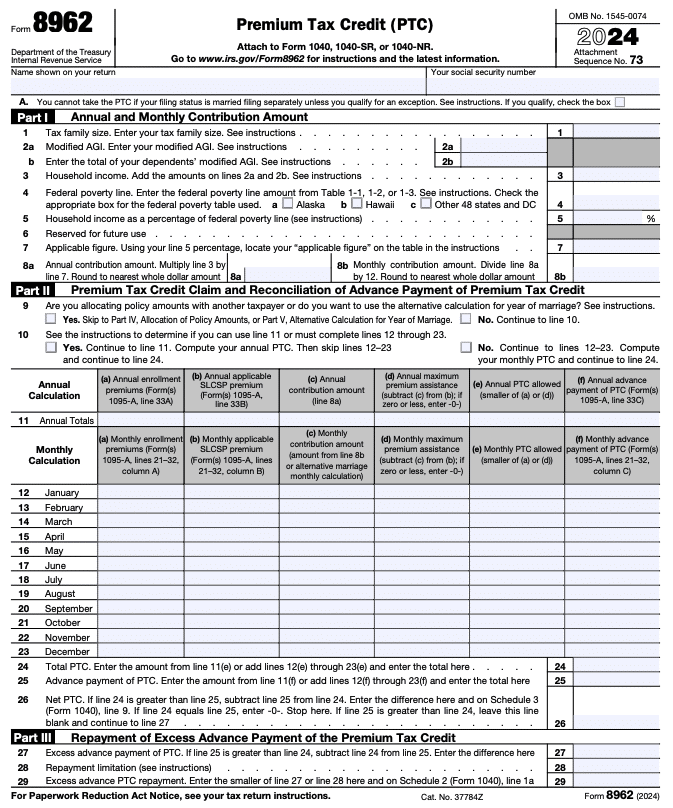
When you enroll, the exchange calculates your subsidy based on an estimated projection of your upcoming annual earnings. When you file taxes at year-end, the IRS reconciles that projection against your actual finalized tax return using IRS Form 8962 (Premium Tax Credit).
If you earned more than you projected, you received an “Excess Advance Premium Tax Credit” that must be repaid. To protect yourself from unexpected tax liabilities, execute these three strategic maneuvers:
Maneuver 1: Report Income Changes Within 30 Days
Do not wait until December to update your financial status. Marketplace rules ask you to report changes—including raises, freelance income changes, marriage, or changes in household size—promptly, generally within 30 days. The exchange recalculates your monthly APTC in real time, preventing an unmanageable repayment balance from quietly accumulating over twelve months.
Maneuver 2: Deploy Above-the-Line Tax Shields Before Tax Day
If you discover in December or March that your income jumped past a critical FPL threshold, you can retroactively lower your ACA MAGI before filing your federal return:
- Max Out a Traditional IRA: Contributing up to the annual limit directly reduces your Adjusted Gross Income on Line 11 of Form 1040, dragging your MAGI down into a higher subsidy tier or below a repayment cap.
- Fund a Health Savings Account (HSA): If enrolled in an eligible high-deductible health plan, funding an HSA provides an immediate dollar-for-dollar reduction in your MAGI calculation.
- Contribute to a SEP-IRA or Solo 401(k): For self-employed enrollees, pre-tax retirement plan contributions can shelter tens of thousands of dollars from the ACA MAGI formula.
Maneuver 3: Know Whether Repayment Limits Apply to Your Tax Year
For tax years through 2025, households with income under 400% of the FPL had a dollar limit on how much excess advance credit they had to repay, with the limit depending on income and filing status. Federal law has since changed how repayment works for later tax years, and the limits may no longer apply. Do not assume a cap will protect you: check the IRS instructions for Form 8962 for the year you are filing, or ask a tax professional. Our guide to what happens if you underestimate income explains the reconciliation step.
5. A Hypothetical Example
The figures below are hypothetical and are not based on any particular year’s tables. Sam is self-employed and estimates $40,000 of income when enrolling. Based on that estimate, the Marketplace pays $400 a month toward Sam’s premium, or $4,800 for the year. In the fall, Sam lands a large contract, and actual MAGI ends up at $52,000. At tax time, Form 8962 recalculates the credit using the higher income, and suppose the result is that Sam was only entitled to $3,300. The $1,500 difference is excess advance credit that Sam may need to repay with the tax return.
Had Sam updated the Marketplace application when the contract was signed, the monthly credit would have dropped for the remaining months and the year-end difference would have been smaller. Sam could also ask a tax professional whether a deductible retirement or HSA contribution would lower MAGI for the year.
6. Common Mistakes to Avoid
- Using take-home pay. The Marketplace asks for projected MAGI for the whole household for the whole year.
- Forgetting one-time income. Bonuses, capital gains, retirement account withdrawals and unemployment benefits can all count.
- Leaving out a household member’s income. Income from a spouse and from dependents who are required to file generally counts.
- Never updating the application. An estimate made in November can be far off by the following summer. See how seasonal income spikes affect subsidies.
- Skipping Form 8962. If you received advance credits, you generally must file a return and reconcile, even if you would not otherwise need to file.
Frequently Asked Questions
What income counts for ACA subsidies?
Your household’s Modified Adjusted Gross Income: adjusted gross income plus untaxed foreign income, tax-exempt interest and non-taxable Social Security benefits.
What if I overestimate my income?
You will have received less advance credit than you qualified for, and the difference generally comes back to you as a larger refund or smaller balance due when you file.
Is there still a “subsidy cliff” at 400% of the poverty level?
It depends on the plan year. The cliff was suspended for several years under temporary legislation. Check HealthCare.gov or your state exchange for the rules that apply to the year you are enrolling.
Can I choose a Bronze plan and still get cost-sharing reductions?
Generally no. Cost-sharing reductions are available on Silver plans for people who qualify by income, with different rules for members of federally recognized tribes. Read more in our guide to cost-sharing reductions.
Who can help me estimate my income?
Marketplace navigators can help with the application at no charge, and a tax professional can help you project MAGI and plan contributions.
The Bottom Line
The Affordable Care Act offers substantial financial protection, but its subsidy architecture demands vigilant tax planning. Treating marketplace health insurance as a dynamic financial asset rather than an automated utility prevents severe tax liabilities. By monitoring your MAGI, prioritizing Silver plans with Cost-Sharing Reductions, adjusting mid-year projections promptly, and deploying pre-tax retirement deductions, you can secure affordable premium rates and eliminate surprise tax liabilities.