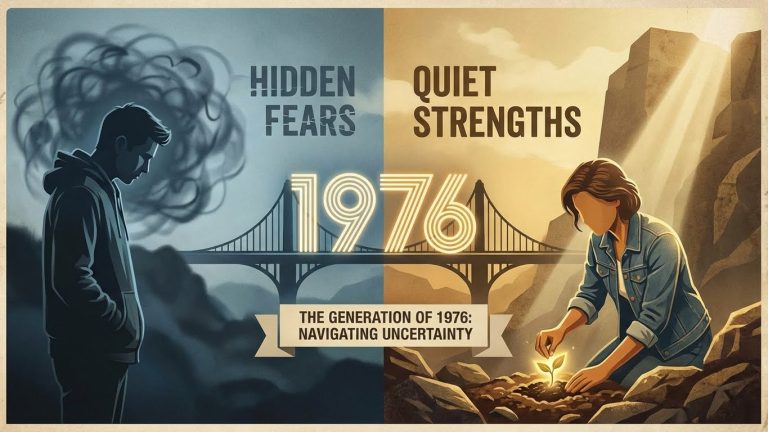
Introduction: The Silent Sentinels of the Mid-Seventies
As the year 2026 approaches, a specific group of people is preparing to cross the threshold into their fifties. Born in 1976, these individuals represent the absolute core of Generation X. They are not the “Jonesers” who remember the moon landing, nor are they the “Xennials” who grew up with the Oregon Trail on Apple IIe computers in elementary school.
Those born in 1976 occupy a unique, almost sacred space in the timeline of the 20th century. They arrived during a period of profound transition—post-Vietnam, post-Watergate, and right at the dawn of the digital revolution. Today, they are the “Sandwich Generation,” squeezed between the needs of aging parents and the demands of digital-native children.
Yet, in an era defined by “oversharing,” “vulnerability,” and “quiet quitting,” the 1976 cohort remains remarkably silent. They don’t post tearful videos about burnout; they don’t demand systemic overhauls when they are tired; they simply keep going. To understand why they don’t complain—even when the weight of the world seems designed to crush them—we must look at the specific psychological scaffolding that was built during their formative years. They are a generation that learned to endure long before they were ever told it was okay to rest.

I. The Latchkey Crucible: Independence as Survival
The most defining characteristic of the 1976 child’s upbringing was the absence of supervision. In the late 70s and early 80s, the social contract of parenting underwent a seismic shift. Divorce rates were peaking, and the dual-income household became an economic necessity.
For the ’76ers, this birthed the “Latchkey” lifestyle. By the age of eight or nine, these children were expected to navigate the world with a level of autonomy that would be considered criminal neglect by today’s “helicopter parenting” standards.
The Empty House
Coming home to an empty house at 3:30 PM was not a tragedy; it was a Tuesday. The child of ’76 knew how to:
- Navigate a neighborhood without a GPS or a phone.
- Prepare a meal using a stove or an early-model microwave.
- Resolve conflicts with siblings or peers without an adult mediator.
- Manage hours of solitude without the digital stimulation of the internet.
The Internalization of Problems
When a child of 1976 fell and scraped their knee, or felt the sting of a playground bully’s words, there was often no one there to witness it. By the time their parents returned home at 6:00 PM—exhausted, stressed, and carrying their own heavy burdens—the child had already processed the pain.
They learned early on that complaining was an inefficient use of energy. If you cried in an empty house, the house didn’t cry back. You simply wiped your face, put on a Band-Aid, and started your homework. This fostered a deep-seated belief that they were the primary solution to their own problems. Resilience wasn’t a “wellness goal”; it was a survival mechanism.
II. The Analog Adolescence: The Luxury of Private Failure
The 1976 cohort graduated high school in 1994. This timing is critical. They are the last generation to experience a fully analog adolescence.
The Sanctity of the Bedroom
For a teenager in the early 90s, the bedroom was a fortress. If you were depressed, you didn’t seek validation from thousands of strangers on Reddit. You made a mixtape. You sat in the dark and listened to The Downward Spiral or Automatic for the People. You wrote in a journal that you hid under your mattress.
Because their struggles were processed in private, they never developed the “performative” aspect of suffering. Today’s younger generations are often criticized for “trauma dumping” on social media, but for those born in 1976, that concept is utterly alien. To them, displaying one’s heavy heart to the public feels like a betrayal of the self.
Waiting as a Virtue
The ’76ers grew up in a world defined by latency.
- They waited a week to see if a girl would call the landline.
- They waited months for a movie to move from theaters to the video rental store.
- They waited for the 6:00 PM news to find out what was happening in the world.
This “enforced patience” created a high threshold for frustration. When life gets heavy today, they don’t expect an immediate fix. They are used to the “long game.” They understand that some seasons of life are simply meant to be endured until the weather changes.

III. The Grunge Ethos: Irony as a Shield
By the time the people born in 1976 reached their late teens, the “Greed is Good” era of the 80s had collapsed into the cynical, iron-clad world of the 90s.
The “Whatever” Philosophy
The cultural soundtrack of their youth—Grunge—was a rebellion against the plastic perfection of the previous decade. Kurt Cobain, Eddie Vedder, and Layne Staley sang about pain, but they did so with a sense of weary resignation. The catchphrase of the era was “Whatever.”
This wasn’t just a word; it was a psychological defense. If you don’t care too much, you can’t be hurt too much. If you expect the world to be a bit “heavy,” you aren’t surprised when it becomes so. Those born in 1976 adopted a layer of irony and cynicism that protects them to this day. When life hits them with a crisis, they often respond with a dark joke and a shrug. They were raised to believe that the system was broken anyway, so why bother complaining about the debris?
The Rejection of the Hero Narrative
Unlike the Baby Boomers, who were told they could change the world, or Millennials, who were told they were “special,” Gen Xers born in 1976 were told they were the “Slackers.” They were the “forgotten” middle children. Being ignored by society gave them a strange kind of freedom. They didn’t feel the pressure to be heroes; they just felt the pressure to function.
IV. The Sandwich Generation: The Peak of the Load
Currently, those born in 1976 are in the most intense phase of the human lifecycle. They are the “pivots” of society.
The Parental Burden
Their parents (Baby Boomers and the Silent Generation) are entering their late 70s and 80s. The ’76ers are now the primary caregivers, navigating the complexities of Medicare, dementia, and terminal illness. They are the ones holding the hands of the generation that taught them to be tough.
The Digital Native Children
Simultaneously, they are raising Gen Z and Alpha children. They are trying to parent through a digital revolution they didn’t experience as kids. They are the bridge between the world of “play outside until the streetlights come on” and the world of “social media algorithms.”
The Career Ceiling
In the workplace, they are often the “workhorses.” They have the institutional knowledge of the old guard but the tech-savviness to keep up with the new. They are often the ones doing the actual labor while being managed by older Boomers who won’t retire and being pushed by younger Millennials who want their jobs.
Why don’t they complain? Because they feel that if they stop, everything falls apart. They are the glue. If the glue fails, the family shatters and the office stalls. Their silence isn’t necessarily a sign of peace; it’s a sign of maximum load capacity.

V. The Biological Reality: The Midlife Stoic
There is also a biological component to why this group keeps their head down. By 48 or 49, the 1976 cohort has seen enough of life to know that “complaining is a luxury of the young.”
The Wisdom of Finite Energy
They realize that emotional energy is a finite resource. They can either spend an hour venting about their stress, or they can use that hour to solve the problem or sleep. Most ’76ers choose the latter. They have developed a “triage” mentality:
- Is it life-threatening?
- Can I fix it right now?
- If not, can I endure it until I can fix it?
The Distrust of “Self-Care”
While the modern world promotes “self-care” as bubble baths and mental health days, the 1976 cohort often views these concepts with suspicion. To them, “self-care” looks like finishing a project early so they can have a quiet beer on the porch, or finally fixing the leaky faucet that’s been bothering them. Their version of “rest” is the absence of a task, not the presence of a luxury.
VI. The Cost of the Silence
While their endurance is heroic, it comes at a significant price. The “never complain, never explain” motto of the 1976er leads to specific risks that are only now beginning to surface.
The Physical Manifestation of Stress
Because they don’t vent, their stress goes internal. This generation sees high rates of hypertension, autoimmune issues, and “mysterious” fatigue. They aren’t burning out in a way that looks like a dramatic meltdown; they are burning thin. They are like a candle that has been burning at both ends for thirty years.
The Emotional Isolation
Their stoicism can sometimes make them appear cold or unapproachable to their partners and children. A Millennial spouse might ask, “Why won’t you tell me how you’re feeling?” and the ’76er honestly doesn’t know how to answer, because they’ve spent forty years suppressing the vocabulary of struggle.
The “I’m Fine” Reflex
The most dangerous phrase in the 1976 vocabulary is “I’m fine.” It is a conversational dead-end designed to protect others from their burden. But when you say “I’m fine” long enough, you eventually lose the ability to recognize when you are actually in a crisis.
VII. Why They Are the Most Resilient Generation
Despite the risks, there is something deeply admirable about this group. They are the “Black Ops” of the human race. They get the job done without needing a “likes” or “retweets.”
The Reliability Factor
If you want something done in a crisis, you find someone born in 1976. They don’t panic. They don’t look for someone to blame. They don’t check the employee handbook for a “stress clause.” They look at the problem, find the tools, and start working.
The Unspoken Bond
There is a secret language between people of this age. When two ’76ers meet, they don’t need to exchange long stories of their hardships. A simple look—a weary, knowing nod—is enough. It says: I see your load. I’m carrying mine, too. We’re still here.
VIII. Conclusion: Learning to Rest Before the Break
The people born in 1976 are the last of a breed. They are the final generation to be raised by the “Old World” rules of toughness and privacy, while successfully navigating the “New World” of transparency and speed.
They don’t complain because their childhood taught them it was useless, their adolescence taught them it was uncool, and their adulthood taught them they didn’t have the time. They have spent their lives as the shock absorbers of history.
However, as they turn 50, the message to the class of ’76 needs to change. Endurance is a virtue, but it is not a destination. The weight of life is not going to get lighter in the coming decade. As they move into the “third act” of their lives, the greatest challenge for the 1976er will not be another project, another parent to care for, or another crisis to manage. Their greatest challenge will be learning how to unclench their jaw. It will be learning that asking for help is not a betrayal of their “latchkey” roots, but a necessary evolution for the next fifty years.
They have proven they can endure. Now, it is time to see if they can learn to rest.

A Final Thought for the Class of ’76
If you were born in 1976, take a moment to look at your hands. They have carried keys, tapes, heavy textbooks, children, dying parents, and the weight of a thousand silent responsibilities. You don’t complain because you are strong. But remember: even the strongest bridge needs maintenance. You’ve done the work. You’ve endured the silence. Now, perhaps, it’s okay to say, just once: “This is heavy.” The world won’t fall apart if you do. We promise.