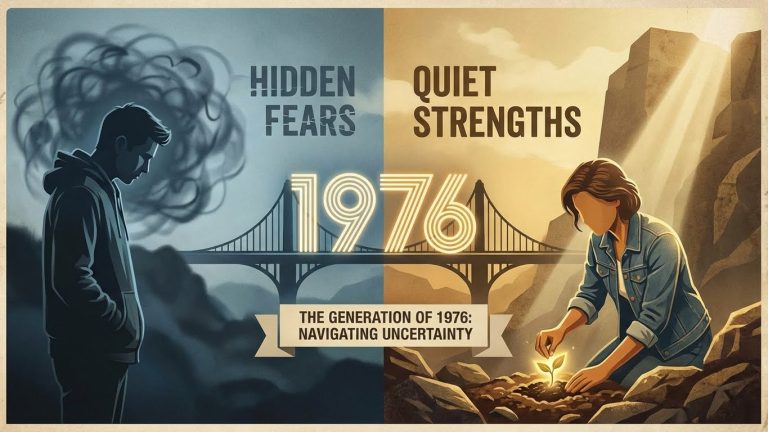
Introduction: The Bicentennial Babies and the Pivot Point
To be born in 1976 is to arrive at a peculiar inflection point in history. These “Bicentennial Babies” entered the world when the United States was celebrating its 200th birthday with fireworks and tall ships, a massive projection of confidence and stability. Yet, the ground beneath that celebration was already shifting tectonically.
People born in this year are squarely members of Generation X, but they sit on a unique cusp. They are old enough to have substantial, formative memories of an analog world—a world of rotary phones, card catalogs, and Cold War anxieties—yet young enough to have adopted the digital revolution during their crucial coming-of-age years. They turned 18 in 1994, the year Netscape Navigator launched and grunge music peaked. They turned 30 just before the Great Recession of 2008 decimated the global economy.
Today, as they approach or enter their 50s, this cohort possesses a distinct, often misunderstood relationship with the concept of “stability.” Unlike the Baby Boomers before them, who largely inherited an ethos of corporate loyalty and pension-guaranteed futures, and unlike the Millennials after them, who entered a fragmented gig economy where instability was the baseline, those born in 1976 see stability not as a promise, but as a construct.
For the class of ’76, stability is not something you are given; it is something you build, often aggressively and skeptically, using tools forged in a childhood of economic uncertainty and young adulthood of rapid technological upheaval. Their worldview is defined by a deep-seated belief that the only reliable safety net is self-reliance. To understand why they think this way, we must peel back the layers of the decades that shaped them.
Section 1: The Formative Years – Cracks in the Post-War Dream
The late 1970s and early 1980s were not the idyllic “Happy Days” retro-fantasy often portrayed on television at the time. For a child born in 1976, the backdrop of their earliest memories was characterized by a palpable sense of national malaise and economic erosion.
By the time they were four years old, inflation hit staggering highs. Their parents were grappling with oil crises, gas lines, and mortgage rates that hovered around 18%. The social contract that had defined the American middle class since World War II—the idea that if you worked hard for one company, they would take care of you for life—was actively dissolving. They watched their parents, perhaps Boomers or the Silent Generation, face layoffs as manufacturing jobs went overseas and corporate restructuring became the norm.
This background noise of financial anxiety was foundational. A child doesn’t understand interest rates, but they acutely understand the tension at the dinner table when parents discuss bills. They internalize the lesson that external systems are fragile.
Furthermore, this cohort became the quintessential “latchkey kids.” With rising divorce rates and the economic necessity of both parents entering the workforce, the children of 1976 were often left to their own devices after school.

This unsupervised time was crucial. It forced an early independence. Stability wasn’t provided by a hovering parent; it was maintained by the child themselves—remembering the house key, making a snack, starting homework, and navigating the hours until dinners. This engendered a premature maturity and a sense that one is ultimately responsible for one’s own immediate environment. They learned to troubleshoot boredom, minor crises, and loneliness without immediate adult intervention. The seed was planted: if you want things to be stable, you have to manage them yourself.
Section 2: The 1990s Coming-of-Age – Skepticism as a Survival Skill
If the 80s provided the economic anxiety, the 90s provided the cultural framework for how those born in 1976 processed it. They entered high school as the Cold War ended and the Gulf War began. They graduated high school in 1994, right into the teeth of an early-90s recession that made job prospects for young people seem bleak.
This era birthed the defining aesthetic of Generation X: cynicism. But this wasn’t just teenage angst; it was a rational response to the world they were inheriting. They saw political scandals erode trust in government. They saw the AIDS crisis ignored by those in power. They saw the superficial glitz of the 80s give way to a grittier reality.
Culturally, this manifested in grunge music, hip-hop emerging as a dominant global force, and a pervasive sense of irony in media. The heroes of this generation weren’t suit-clad executives; they were anti-heroes who rejected the mainstream definition of success. The message received by a 20-year-old in 1996 was clear: The institutions your parents trusted are flawed, if not outright corrupt. Don’t buy the hype.
Consequently, their view of stability shifted away from institutional reliance toward personal authenticity and skepticism. A stable career wasn’t necessarily climbing a corporate ladder—which they viewed as a greasy pole anyway—but finding work that felt somewhat meaningful, or at least didn’t require selling one’s soul. They became the pioneers of the “work to live, don’t live to work” mentality, prioritizing a kind of lifestyle stability over mere financial maximization. They were skeptical of “selling out” because they suspected the buyers weren’t good for the money anyway.

This skepticism is a cornerstone of how they view stability today. They are less likely to trust financial advisors implicitly, less likely to believe politician’s promises of security, and more likely to read the fine print on any “guaranteed” offer. Their stability is built on a foundation of “trust, but verify”—with a heavy emphasis on the verification.
Section 3: The Digital Bridge – Adaptability as the New Stability
Perhaps the most defining characteristic of someone born in 1976 is their position as the bridge between the analog and digital eras. This is not merely a trivia point; it fundamentally rewired their brains regarding what “secure” knowledge means.
They went through elementary school learning cursive and using encyclopedias that were current as of three years prior. They wrote college papers by doing physical research in libraries. Yet, by the time they entered the professional workforce in their early 20s, email was becoming standard, the internet was exploding, and entire industries were beginning to digitize.
Unlike Millennials, who were born into the digital stream, the 1976 cohort had to consciously learn the transition. They remember the effort involved in adopting new technologies. They remember when “stability” meant knowing a trade; suddenly, stability meant the ability to unlearn that trade and learn a new software package every two years.
This experience taught them that static knowledge is a liability. Stability in the modern world isn’t about what you know right now; it’s about your capacity to adapt when what you know becomes obsolete.
They are the youngest generation to remember a slower pace of life, giving them a touchstone for what “offline stability” feels like, yet they are old enough to have masterfully adopted digital tools to enhance their productivity. This duality makes their version of stability highly pragmatic. They use technology as a tool to create efficiency and security, but they are less likely than younger generations to trust technology implicitly with their well-being. They are the generation most likely to have a fully digitized cloud backup system, but also a fireproof safe with physical copies of their most important documents.

For the 1976 cohort, technological adaptability is job security. They learned early on that if you didn’t master the new system—be it Windows 95, the BlackBerry, or cloud computing—you would be left behind. Therefore, their sense of stability is intrinsically tied to their own ability to remain relevant in a shifting technological landscape.
Section 4: The Great Recession – The Lesson Reinforced
If childhood taught them resources were scarce, and the 90s taught them institutions were untrustworthy, their early 30s provided a brutal masterclass in economic fragility.
By 2007, people born in 1976 were hitting their stride. They were roughly 31 years old. Many had bought their first homes, perhaps stretching their finances to do so in a booming market. They were moving into mid-level management, starting families, and finally feeling like they had achieved a measure of the adult stability they had long sought.
Then came 2008. The financial crisis and the Great Recession that followed was a defining trauma for this cohort. They watched the value of their homes plummet underwater. They saw retirement accounts (401ks, which had replaced the stable pensions of their parents) vanish overnight. They faced layoffs right at the point in their careers when they were supposed to be most secure.
This wasn’t an abstract news event; it was a direct assault on their burgeoning stability. It reinforced every cynical lesson they had learned in the 90s and every anxiety they had absorbed in the late 70s. The takeaway was devastatingly clear: You can do everything “right”—go to college, get the job, buy the house—and the system can still pull the rug out from under you.
This experience cemented a deeply conservative (in the risk-averse sense, not political) approach to stability. Post-2008, the 1976 cohort became intensely focused on debt reduction, emergency funds, and diversifying their income streams. “Stability” no longer meant a high salary on paper; it meant having enough liquidity to survive six months if the world ended again. It meant skepticism toward bubbles and a preference for tangible assets.
Furthermore, as they moved through their 30s and 40s, they found themselves squeezed as the “sandwich generation”—simultaneously caring for aging parents (who were often hit hard by the recession themselves) and raising their own children in an increasingly expensive world. The pressure to provide stability for those above and below them on the generational ladder intensified their need for control over their own financial destiny.
Section 5: Redefining Stability at Mid-Life
Today, as they navigate their late 40s, people born in 1976 have synthesized these experiences into a unique philosophy. They are often the stabilizers in the workplace—the pragmatic bridge between Boomer leadership and Millennial/Gen Z workforces.
Their view of stability has matured. It is no longer just about defensive cynicism or financial hoarding. It has evolved into a holistic view of resilience.
1. Stability as Autonomy: They value control over their time and work above flashier titles. The “gig economy” isn’t entirely alien to them; they were the originators of “freelance nation” in the late 90s and early 2000s. They prefer stability that they own, rather than stability that is rented from an employer. This makes them highly entrepreneurial, or at least “intrapreneurial” within larger organizations.
2. Emotional and Mental Stability: Having grown up in an era where mental health was rarely discussed, and then living through decades of high-stress change, this cohort places a high premium on psychological stability. They are the generation that began normalizing therapy and wellness practices, realizing that external stability is meaningless without internal equilibrium.
3. The Long Game: Unlike younger generations who may feel hopeless about the future due to climate change or economic disparity, and unlike older generations holding onto past models, the 1976 cohort is focused on endurance. They are preparing for a long second act. Their version of stability involves staying healthy enough to keep working, staying skilled enough to remain employable, and having enough resources to weather the inevitable next storm.
Conclusion: The DIY Stabilizers
People born in 1976 are the architectural survivors of late-20th-century upheaval. They were not handed a blueprint for a stable life; they were handed a pile of mismatched bricks—some crumbling, some untested—and told to build a shelter in high winds.
Their view of stability—that it is fleeting, hard-won, and ultimately a personal responsibility—is a direct consequence of growing up in the shadow of inflation, coming of age in an era of skepticism, pivoting between analog and digital worlds, and having their prime earning years rocked by financial collapse.
They do not look to corporations or governments to save them. They save themselves. And in doing so, they have developed a resilient, adaptable, and highly pragmatic form of stability that may be the most viable model for the uncertain decades ahead. They know the boat will rock again; they just make sure they are the ones holding the tiller when it does.