Introduction: The Silent Generation X Core
As the calendar creeps inexorably forward, the cohort born in 1976 is standing on the precipice of a significant milestone: turning 50. They are the quintessential Generation Xers. They aren’t the early Gen Xers who vaguely remember Vietnam, nor are they the “Xennials” who dipped a toe into the digital infancy of the early 80s. Those born in our bicentennial year sit squarely in the middle of the generational map.
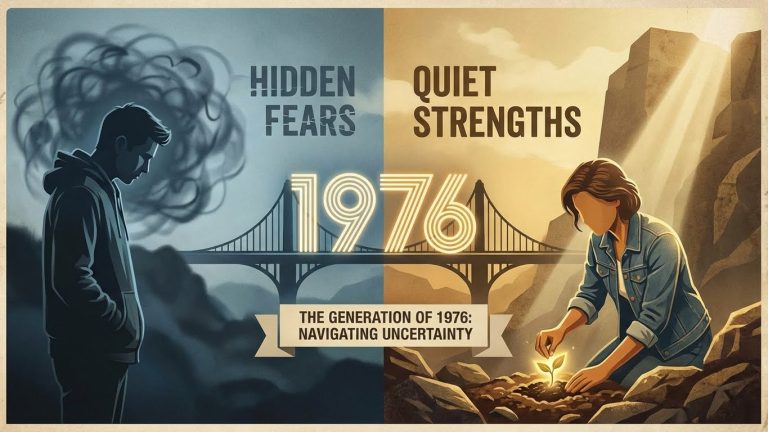
Today, they are likely managing complex careers, raising teenagers who speak a different digital language, and navigating the declining health of aging Baby Boomer parents. Their plates are not just full; they are overflowing. Yet, if you listen closely to the cultural conversation about stress, burnout, and systemic grievances, the voices of the 1976 cohort are strangely muted.
Why don’t they complain? When life gets heavy—and for this group, it is currently very heavy—their default reaction is rarely to vocalize their struggle, take to social media with a tearful confession, or demand immediate systemic change. Instead, they exhibit a specific brand of stoicism. It’s not necessarily a healthy repression, but rather a deeply ingrained behavioral response forged by a unique set of historical, cultural, and technological circumstances during their formative years. To understand their silence today, we have to look at how they were built yesterday.
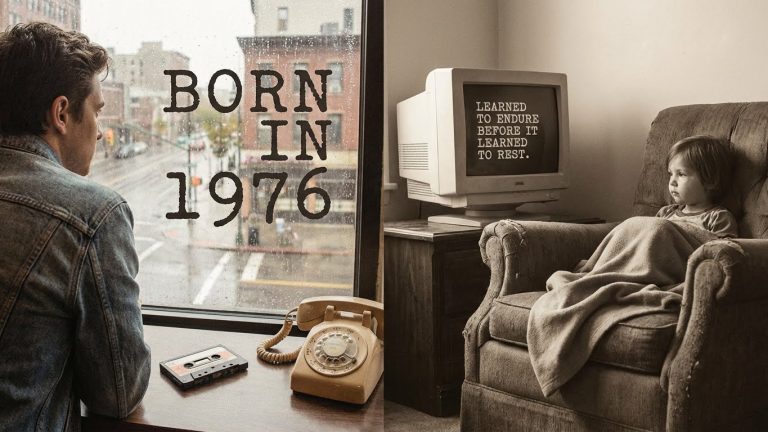
Prompt: A grainy, film-style photograph from the late 1970s showing a solitary child, around 3 or 4 years old, sitting on a shag carpet floor watching a large, wooden console television. The colors should be muted earth tones—browns, oranges, and avocado greens. The atmosphere is quiet and slightly solitary.
The Crucible of the Latchkey: Forging Self-Reliance
To understand the psyche of someone born in 1976, you must understand the landscape of American childhood in the late 1970s and 1980s. This was the era marked by a dramatic societal shift: the rise of the dual-income household and a skyrocketing divorce rate.
The children of ’76 were the definitive “latchkey kids.” They were the first generation for whom it was statistically normal to come home to an empty house after school. From a young age, perhaps seven or eight years old, they carried a literal key—often on a shoelace around their necks—that unlocked not just a front door, but a reality of solitude.
Between 3:30 PM and 6:00 PM, these children were masters of their own micro-universe. They let themselves in, fixed their own snacks (often involving a microwave or a toaster oven), started their homework, and entertained themselves without adult supervision. There were no cell phones to track their movements. Parents were unreachable at work except for genuine emergencies.
This daily routine was a crucible that forged intense self-reliance. If you were hungry, you figured out how to eat. If you were bored, you invented a game. If you were scared of a noise in the basement, you grabbed a baseball bat and waited it out.
Crucially, if something went wrong—a scraped knee, a difficult math problem, a mean remark from a friend—there was nobody there to complain to immediately. The urge to vent had to be suppressed until a parent arrived home, tired and stressed from work. By then, the urgency of the complaint had often faded, or the child instinctively realized that adding their burden to their parents’ load was counterproductive.
They learned, at a visceral level, that the world did not stop to soothe them. Complaining to an empty room was futile; action was the only remedy. This early training in emotional self-management is the bedrock of their adult stoicism.
The Analog Adulthood: The Last Private Generation
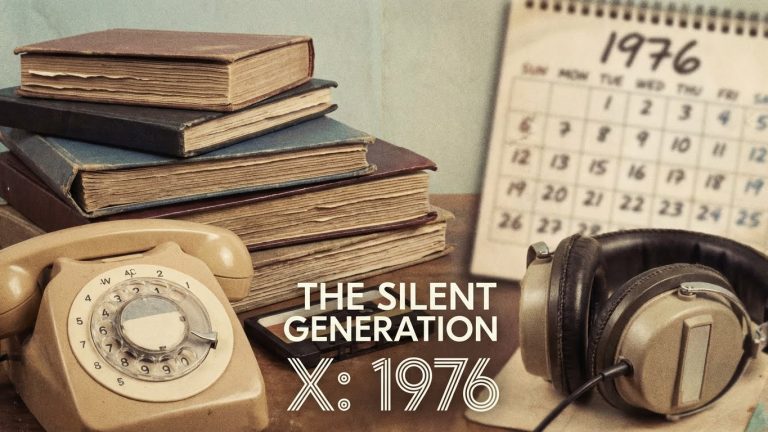
The 1976 cohort has a unique relationship with technology. They are perhaps the last group to have a fully analog childhood and adolescence, but who hit adulthood just as the internet revolution took hold. They graduated high school in 1994, largely before email was common outside of universities. They went to college with landlines in their dorm rooms.
This timing is critical. It means their formative mistakes, their awkward phases, and their youthful angst were not documented for a global audience. They didn’t have Instagram to perform their happiness, nor did they have TikTok to perform their trauma.
When a teen born in 1976 was upset, they wrote in a physical diary that locked with a tiny key. They talked on a telephone tethered to a wall, stretching the cord down the hallway for a semblance of privacy. If they got their heart broken, they made a mixtape and brooded in their bedroom.
Because their struggles were processed privately or within very small, tight-knit peer groups, they never developed the reflex of “performative vulnerability” that defines later generations. They didn’t learn to crowd-source emotional support.
Furthermore, they remember a world where you just had to wait. You waited for the song you liked to come on the radio to tape it. You waited by the phone for a call. You waited for photos to be developed to see if they were any good. This baked-in patience means they are less likely to demand instant gratification or immediate solutions to complex problems today. They are accustomed to the lag time between a problem arising and its resolution.
Prompt: A still life photograph representing the mid-1990s. On a worn wooden desk sit a stack of cassette tapes with handwritten labels, a chunky beige landline telephone with a coiled cord, a flannel shirt draped over a chair, and a bulky CRT monitor displaying a very basic, text-based early internet browser screen. The lighting is natural, coming from a window.
Cultural Cynicism and the Soundtrack of Irony
By the time the class of ’76 hit their late teens and early twenties, the cultural landscape shifted dramatically into the ethos of the 1990s. This was the era that rejected the glossy consumerism of the 80s in favor of grunge, irony, and a pervasive skepticism toward established institutions.
Growing up in the shadow of the Cold War, only to see the wall fall, and maturing during the relatively stable but culturally cynical Clinton years, this group learned to distrust grand narratives. They saw through the “greed is good” mantra of the decade they were born into and adopted a protective layer of detachment.
The soundtrack of their coming-of-age reinforced this. Nirvana, Pearl Jam, and Soundgarden didn’t sing about overcoming obstacles with a smile; they screamed about internal pain, apathy, and the feeling of being misunderstood. Yet, crucially, this angst wasn’t a plea for help—it was a statement of fact. The prevailing attitude was “Whatever” and “Nevermind.”
To care too much, to try too hard, and especially to complain loudly, was seen as uncool. Irony became a shield. If you didn’t take anything too seriously, nothing could truly hurt you. This cultural programming taught them that earnest complaints were gauche. You deal with the darkness by acknowledging it with a wry grin, a sarcastic remark, and then you move on. You don’t dwell on it publicly.
The Great Generational Sandwich
Sociologically, those born in 1976 are the ultimate middle children. They are squeezed between two massive, vocally dominant generations: the Baby Boomers and Millennials.
Throughout their lives, the ’76 cohort has watched Boomers utilize their sheer demographic weight to shape policies and cultural norms. They then watched Millennials utilize digital platforms to loudly demand changes in the workplace, mental health awareness, and social justice.
Gen X, vastly smaller in numbers than both, realized early on that nobody was listening to them anyway. If Boomers sucked up the resources and Millennials sucked up the airtime, Gen X just kept their heads down and did the work. They became the pragmatic operators in the background.
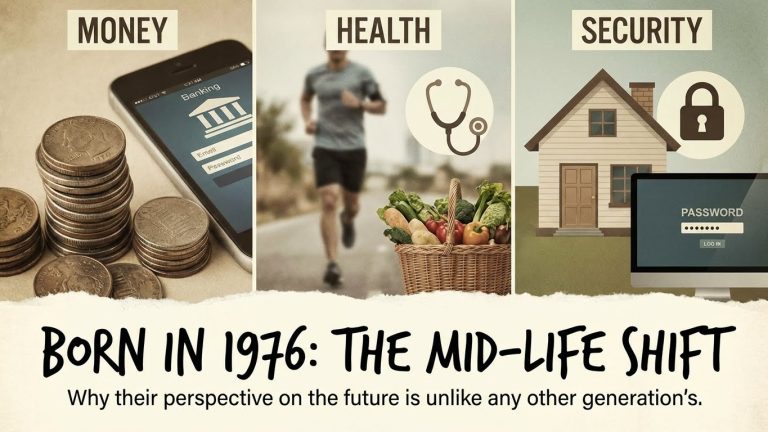
Now, in their late 40s, this “sandwich” effect has moved from a sociological concept to a crushing daily reality. A typical person born in 1976 is likely managing the complex emotional and financial needs of teenagers (Gen Z) while simultaneously coordinating healthcare, finances, and living arrangements for aging parents (Boomers/Silent Gen).
They are the pivot point upon which family structures currently rest. The pressure is immense. Yet, the habit of silence prevails. Who would they complain to? Their parents don’t want to hear it, and their kids are dealing with their own modern anxieties. So, the ’76er absorbs the shock, manages the logistics, and keeps the gears turning, often feeling that to stop and complain would be to let the whole delicate ecosystem collapse.
Prompt: A candid photo of a person, dressed in smart-casual work clothes, sitting at a cluttered kitchen table late at night. They are rubbing their temples with one hand, looking exhausted. On the table are an open laptop showing spreadsheets, a pile of medical bills, and a school backpack. The lighting is dim, coming from a single overhead lamp. The mood is one of quiet, overwhelming responsibility.
It’s Not That They Don’t Feel—It’s How They Proces
It is vital to make a distinction here: not complaining is not the same as not suffering.
The 1976 cohort is not made of stone. They experience burnout, depression, anxiety, financial terror, and existential dread just as acutely as any other human beings. In fact, the specific pressures on them right now—peak career demands colliding with peak family caretaking—are a recipe for mental health crises.
The difference lies in the outlet. For someone born in 1976, complaining is often viewed as unproductive at best, and a burden to others at worst. Their wiring suggests that if you have a problem, you should either fix it or learn to live with it. Broadcasting the problem without a solution feels self-indulgent.
They are more likely to process their heavy loads through solitary activities (running, hobbies that require focus), through dark humor shared with a few equally cynical peers over drinks, or simply by “sucking it up” and pushing through until the weekend.
Is this healthy? Not always. This cohort carries high rates of stress-related physical ailments, and their stoicism can sometimes mask deep-seated issues that require professional help. They are the generation most likely to say “I’m fine” when they are demonstrably drowning.
Conclusion: The Silent Engine
As they approach their 50s, the people born in 1976 remain the quiet engine room of society and family life. They were raised with a key around their neck, taught by the culture to view earnestness with suspicion, and squeezed between louder generations.
They don’t complain when life gets heavy because they were never taught that complaining yields results. They were taught that endurance does. They carry the weight because someone has to, and they’ve always known that “someone” is usually the person staring back from the mirror in the quiet hallway of an empty house. They might be tired, they might be cynical, but they are profoundly resilient—and they will likely keep moving forward, silently, until the job is done.