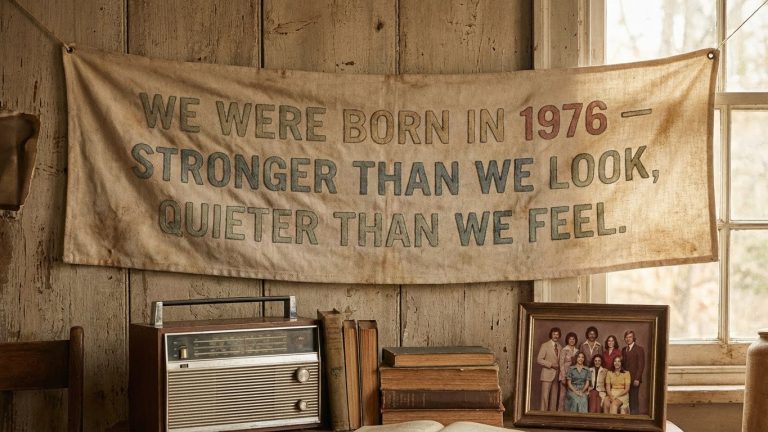
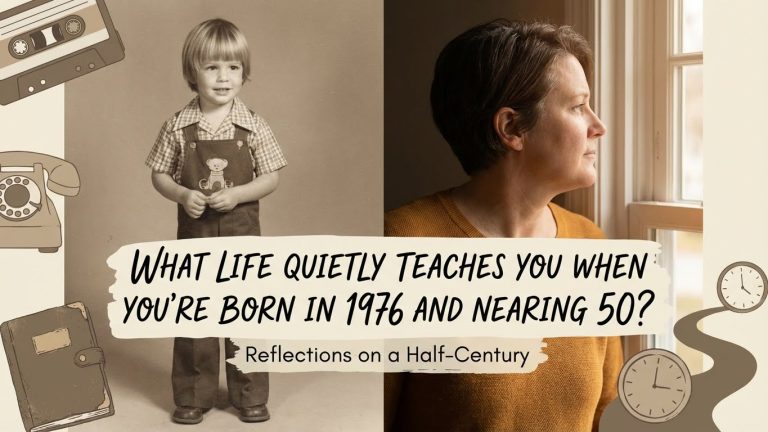
They are the “latchkey adults” turning fifty. Sitting squarely between the loud idealism of Boomers and the loud anxiety of Millennials, the cohort of ’76 carries a unique, silent burden and possesses a resilient set of tools they rarely get credit for.
Introduction: The Architects of the Status Quo
To be born in 1976 is to be a native of the “in-between.” You are the definitive youngest sibling of Generation X. You arrived too late for the collective trauma of Vietnam, the Watergate hearings, or the peak of disco, but your consciousness was fully formed, sealed, and delivered before the internet reorganized human existence.
The year itself was a strange inflection point. It was the American Bicentennial—a massive, backwards-looking celebration of history through a sepia-toned lens. Yet, it was also the year Apple Computer was founded in a garage, the Concorde took its first supersonic commercial flight, and the Viking 1 lander touched down on Mars. You were born into a moment obsessed with the past, yet pregnant with a technological future that few could conceive.
Now, as they approach or settle into their late 40s, this cohort finds themselves in the cockpit of midlife. They are the generation currently tasked with flying the plane while simultaneously upgrading the engines in mid-air. They are largely the ones running the institutions, managing the cross-generational teams, caring for the dying elderly, raising the anxious young, and paying the mortgages that keep the housing market inflated.
Outwardly, the ’76er often projects a competent, slightly weary stability. They are the “adults in the room” who remember when things cost a nickel (metaphorically) and know how to override the automated system when it fails.
But beneath that veneer of capability lies a complex psychological landscape that is rarely discussed. They don’t share their deepest anxieties in viral TikToks, nor do they air their grievances in the entitled op-eds that older generations sometimes favor. Their fears are private, born of a lifetime of seeing certainties crumble just as they reached for them. Yet, precisely because of that unstable history, they have developed a set of quiet, bedrock strengths that are currently holding much of society together.
This is an examination of the private interior of the hinge generation—what keeps them awake at 2 AM, and the specific, hard-won toolkit that gets them out of bed the next morning to fix the world again.

Part I: The Hidden Fears
The fears of the 1976 cohort are not the existential terrors of sudden nuclear annihilation that haunted their early 80s childhoods (though that flavor remains in the background), nor are they the paralyzing climate anxieties or identity crises that define Gen Z. Their fears are intimate, structural, and pervasive. They are the fears of people who know how the sausage is made.
1. The Terror of the “Upgrade Cycle” and Irrelevance
The most potent hidden fear for the ’76er is the terror of rapid, irreversible obsolescence. They are the last generation to possess a working memory of how human society functioned before ubiquitous digitalization. They know how to read a paper map, use a card catalog, navigate by physical landmarks, and maintain friendships without a digital tether.
For twenty years, this was an advantage. They adapted quickly to the internet in their 20s, spearheading the digital revolution. But now, in their late 40s, they are exhausted by the pace of change. They have migrated from WordPerfect to Word, from AOL to broadband, from Myspace to Facebook to Instagram to TikTok, from on-premise servers to the Cloud.
Their hidden fear is that the next shift—be it advanced AI, Web3, or something not yet named—will be the one that finally breaks them. They fear waking up one morning to find that the technological landscape has shifted so radically that their analog foundational knowledge is no longer a useful counterweight, but purely a liability.
They are terrified of becoming the “Boomer parent” at the office—the one who needs a 25-year-old to explain how to share a document, despite having spent their entire adult lives working with computers. They are running on a technological treadmill that is speeding up just as their cognitive energy is naturally starting to plateau. The effort required just to “keep up” is becoming unsustainable, and they fear the moment they have to let go.
2. The Economic Trap Door and Imposter Syndrome
As discussed in previous analyses, this generation was scarred by the 2000 dot-com crash and the 2008 Global Financial Crisis during their prime earning and family-building years. Consequently, their relationship with their own success is fraught with secret panic.
Even successful ’76ers—those with the C-suite titles, the nice suburban homes in good school districts, and the fully leased luxury SUVs—often feel a deep sense of economic imposter syndrome. They don’t feel wealthy; they feel leveraged. Their hidden fear is that their stability is a Potemkin village, a facade built on cheap debt and precarious asset bubbles.
They don’t truly believe in the safety net because they’ve seen it fail during their most vulnerable adult moments. They fear that one corporate merger, one algorithmic market correction, or one AI breakthrough could erase twenty years of climbing the ladder. They are terrified of ending up like the tragic figures in 20th-century American literature—having followed all the rules, bought all the right things, only to find the system has no use for them in their final act. They are the generation with the highest debt and the deepest skepticism about ever being able to truly retire.
3. The Ghost of the Unlived Life (The Gen X Crisis)
There is a specific flavor of midlife crisis reserved for the ’76er. It’s not about buying a red sports car or having an affair; it’s a quieter existential dread about authenticity.
They were raised on the tail end of the Gen X ethos that viewed corporate culture with disdain. “Selling out” was the ultimate sin in 1994. Yet, they entered an adulthood where the cost of living skyrocketed so drastically that “selling out” became necessary for basic survival, homeownership, and raising a family.
Their hidden fear is that they traded their youthful authenticity for a security that turned out to be an illusion anyway. They look in the mirror and see the “Man” they used to mock. They worry that in being the responsible “bridge generation”—the ones who put their heads down and worked through the chaos—they spent too much time maintaining the structure of society and not enough time actually living inside it. The ghost of the 90s slacker artist they might have been haunts the boardroom they now occupy.
4. The Fear of Parenting into the Abyss
Perhaps the most acute, daily fear for the ’76er is parenting digital natives. They are raising children (Gen Z and younger) whose brains are wired for a reality that the ’76er finds alien and often terrifying.
They fear they are the last generation of immigrant parents to a digital new world, their old-country wisdom useless in the face of algorithmic threats. When their child faces cyberbullying, social media addiction, or the paralyzing anxiety of the modern world, the ’76er feels profoundly ill-equipped. Their analog childhood solutions—”go outside,” “just ignore them,” “read a book”—feel criminally inadequate. They fear they are failing to prepare their children for a future they themselves cannot understand.

Part II: The Quiet Strengths
If their fears are defined by instability and obsolescence, their strengths were forged by those very pressures. The cohort of 1976 possesses a unique toolkit of resilience that is currently indispensable to the functioning of modern society.
1. The Superpower of Translation (The Bilingual Generation)
This is their single greatest asset in the 2020s economy. They are the only truly bilingual generation in the workforce. They speak fluent Analog and fluent Digital, with no accent in either.
They understand the hierarchical, face-to-face structures that Boomers built, value, and still largely control. They know how to navigate office politics, the importance of a handshake, and how to read a room without looking at a phone. Yet, they also intuitively grasp the networked, flattened, asynchronous, digital-first communication style of Millennials and Gen Z.
Their quiet strength is their ability to translate between these two warring cultural factions. In a corporate setting, they are the essential membrane. They are the ones interpreting the CEO’s vague, demanding directive into actionable Slack channels and Trello boards for the junior team. Conversely, they are the ones explaining the junior team’s demand for mental health days and remote work to the bewildered CEO in terms of bottom-line risk and retention outcomes. They are the cultural connective tissue that prevents the modern workplace from snapping apart.
2. Latchkey Resilience and MacGyver-ism
The ’76er grew up in the golden age of benign neglect. They were the peak latchkey kids. They came home to empty houses at age ten, let themselves in, and had to figure out snacks, homework, entertainment, and minor emergencies for three hours without adult supervision, without cell phones, and without Google.
This instilled a profound, quiet self-reliance that is rare today. They possess a high tolerance for boredom and ambiguity. When faced with a novel problem—a flat tire, a software crash, a bureaucratic nightmare, a leak under the sink—their first instinct is not to look for a tutorial, call a help line, or find a support group. Their instinct is to tinker, to troubleshoot, to hack a rudimentary solution together with whatever tools are at hand.
They are Comfortable being uncomfortable. They don’t need a perfectly paved path to move forward; they are used to bushwhacking. This low-stakes problem-solving ability makes them incredibly resilient in high-stakes crises.
3. The Stabilizing Force of Cynicism (The BS Detector)
While often viewed negatively, the inherent skepticism of the late-Gen Xer is a vital stabilizing force in an era of rampant disinformation and hype.
Having lived through the boom-and-bust hype cycles of the early internet (remember Pets.com?), the “End of History” geopolitical illusion, and the housing bubble, they have acquired a hard-earned immunity to irrational exuberance.
When a new technology promises utopia (like the initial Crypto hype), or a new corporate initiative promises revolutionary change, or a political movement promises salvation, the ’76er raises an eyebrow. They have heard this song before.
This isn’t negativity; it’s ballast. In an era defined by hysteria, hot takes, and viral contagion, their low-key cynicism acts as a necessary braking mechanism against collective delusion. They are the ones at the back of the room asking the uncomfortable, practical question: “Okay, but how does this actually work in practice, and who is going to pay for it?”
4. The Capacity for Deep Work and Focus
Finally, a strength that is becoming increasingly valuable as it becomes rarer: their brains finished developing before the attention economy fractured human consciousness.
While they are addicted to their phones today like everyone else, they possess a latent muscle memory for deep, unbroken focus. They remember what it feels like to read a book for three hours without checking a notification. They remember watching a movie without second-screening.
When necessary, they can tap into this reserve, unplugging and engaging in the kind of sustained, deep cognitive work that younger generations sometimes struggle to access. In a world of goldfish attention spans, the ability to sit still and focus on one complex thing for an extended period is a genuine superpower.
Conclusion: The Essential Operators
The person born in 1976 often feels like the exhausted middle manager of history. They are squeezed between caring for aging, analog parents who don’t understand the modern world and raising digital children who are terrified by it. They are carrying the cognitive load of three generations. They are tired.
But if you look closely at who is actually keeping the machinery of society running—who is approving the budgets, managing the crises, bridging the cultural divides, and fixing the broken systems—it is often the 48-year-old born in the bicentennial year.
They are the generation that knows how to restart the router—both literally in their homes and metaphorically in their organizations. They don’t need applause, which is fortunate, because as the overlooked middle child of history, they rarely get it. Their hidden fears keep them humble and alert, and their quiet strengths keep them effective. They are the bridge built on the fly, rickety perhaps, weathered certainly, but surprisingly durable, allowing the past to connect to the future without the whole thing collapsing into the abyss.