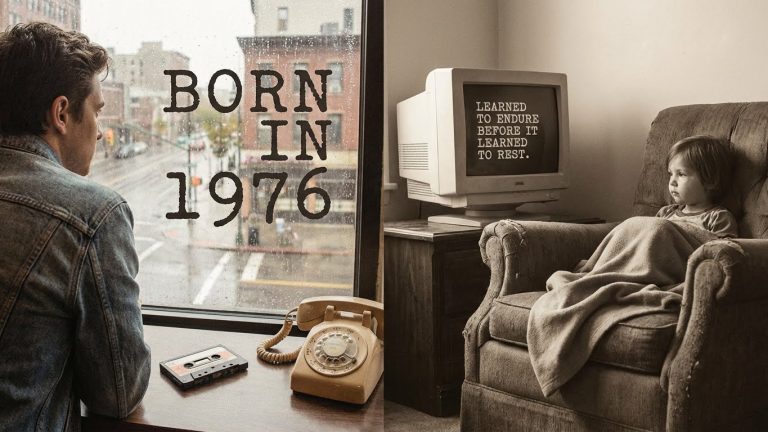
Introduction: The Threshold of 50
As the sun sets on 2025 and rises on 2026, a significant demographic shift is occurring in silence. Those born in 1976—the “Dragon” children of the East and the “Bicentennial” babies of the West—are hitting the half-century mark. In the cultural lexicon, 50 has long been portrayed as a time of crisis: the sports car, the sudden career pivot, the desperate grasp at fading youth.
But if you sit down with a member of the 1976 cohort, you’ll find a surprising lack of anxiety regarding grey hair, slowing metabolisms, or the aesthetic markers of time. For this group, aging is not the enemy. They have lived through enough cultural upheavals to know that a few wrinkles are a small price to pay for the perspective they’ve gained.
However, beneath the surface of their “Generation X” stoicism lies a very specific, visceral dread. It isn’t the fear of growing old; it is the fear of losing independence. For a generation whose entire identity was built on self-reliance, the prospect of needing help—physically, financially, or cognitively—is the ultimate existential threat. They don’t fear the end of the road; they fear being forced into the passenger seat.

I. The Latchkey Foundation: Freedom Was the First Teacher
To understand why independence is the “North Star” for someone born in 1976, we have to revisit their childhood. They were the definitive “Latchkey Kids.”
In the late 1970s and early 80s, the social fabric was tearing and reweaving itself. Divorce rates were at an all-time high, and the era of the stay-at-home parent was rapidly ending as economic pressures forced both parents into the workforce. For the 1976 child, the sound of childhood wasn’t a parent’s voice calling them for dinner; it was the metallic clack of a key turning in a lock as they let themselves into a quiet, empty house after school.
The Cereal-for-Dinner Autonomy
By age nine, a 1976er was a master of their own domain. They knew how to navigate a kitchen without burning the house down, how to entertain themselves for four hours without a screen, and how to resolve a conflict with a sibling or a neighbor without a parent acting as a Supreme Court justice.
This wasn’t just “babysitting themselves”—it was a masterclass in agency. They learned that the world did not stop to help them. If they were bored, they found a book. If they were hungry, they made a sandwich. This early autonomy became the bedrock of their self-worth. To them, competence equals survival. As they age, the idea of a world where they can no longer “make their own sandwich”—metaphorically or literally—feels like a erasure of their very soul.
II. The Analog-Digital Bridge: The “Figure It Out” Generation
The 1976 cohort occupies a rare sliver of history. They are the last generation to remember a world before the internet, yet they were young enough to be its first true architects.
The IT Support for Everyone
Because they grew up “Analog” (rotary phones, paper maps, encyclopedias) but matured “Digital” (email, coding, smartphones), they developed a unique psychological trait: Adaptive Independence. When a 1976er encounters a new piece of technology or a complex problem, their first instinct isn’t to look for a tutorial or call a help desk. Their instinct is to “mess with it” until it works. They are the generation that learned to fix the VCR by poking it with a screwdriver and learned to navigate a new city by reading a physical map under a streetlamp.
In 2025, they are often the “IT support” for their Boomer parents and the “common sense check” for their Gen Z children. This role as the “Fixer” reinforces their need for independence. They are used to being the ones with the answers. The fear of aging, for them, is the fear of becoming the person who asks for help with the remote, rather than the person who fixes it.

III. The “Sandwich” Trauma: Observing the Loss of Agency
The fear of losing independence isn’t just an abstract psychological quirk; for the 1976 cohort, it is based on what they are currently witnessing. In their late 40s, they are the “Sandwich Generation.”
The Cautionary Tale of the Boomers
They are currently spending their weekends navigating the decline of their Baby Boomer parents. They are the ones sitting in doctors’ offices, fighting with insurance companies, and researching assisted living facilities.
They see, in vivid and painful detail, what happens when independence vanishes. They watch their once-powerful, rebellious parents struggle to remember a password, lose their driver’s licenses, and become dependent on the “mercy” of a bureaucratic healthcare system.
To a 1976er, this is the ultimate horror story. They don’t look at their parents and think, “I’m afraid of dying.” They look at their parents and think, “I’m afraid of being managed.” They see the loss of dignity that comes with dependency, and they are silently vowing to do whatever it takes to avoid that fate. This drives their obsession with health, financial planning, and “aging in place.”
IV. Professional Independence: The Mid-Career Pivot
In the professional world, those born in 1976 are often the “Workhorses.” They are the managers and directors who actually know how to do the labor they supervise. They value “low-maintenance” colleagues and pride themselves on being “low-maintenance” employees.
The Fear of Obsolescence as a Loss of Control
As AI and automation reshape the workforce in 2025/2026, the 1976 cohort isn’t necessarily afraid of the tech itself—they’ve adapted before. What they fear is the loss of professional agency. For them, a job isn’t just a paycheck; it’s a proof of utility. If they are useful, they are independent. The prospect of being “put out to pasture” or becoming a “legacy employee” who can’t keep up is terrifying. This is why you see so many people in this age group starting “Side Hustles,” consulting firms, or small businesses. They want to own the means of their own production so that no one can ever tell them they are “done.”

V. Health as a Tool, Not an Aesthetic
While younger generations may exercise for “aesthetic goals” (the perfect Instagram photo) and older generations might exercise because their doctor told them to, the 1976 cohort exercises for Mobility and Autonomy.
Biohacking for the Long Haul
Walk into any gym at 6:00 AM, and you will see them. They are the ones lifting heavy weights, not to get “huge,” but to prevent bone density loss. They are the ones practicing yoga, not for “zen,” but to ensure they can still tie their own shoes when they are 85.
They approach health like a mechanic maintains a classic car. They are highly interested in “longevity” and “healthspan” (the number of years lived in good health) rather than just “lifespan.” For them, a long life spent in a wheelchair is a failure; a shorter life spent on their feet is a victory. This is why they are the primary consumers of wearable health tech—they want the data so they can manage themselves, rather than being managed by a physician later.
VI. The Financial Moat: Protecting the Exit Strategy
Independence requires capital. The 1976er remembers the recessions of the early 90s, the dot-com bubble of 2000, the 2008 financial crisis, and the COVID-19 disruption. They have learned that the “system” is volatile.
The “F-You” Fund as a Security Blanket
For this cohort, retirement planning isn’t about cruises or golf. It’s about building a “moat” around their independence. They want enough money so that, if their health fails, they can hire their own help on their own terms, rather than relying on state-funded facilities.
They are the “Quiet Savers.” They don’t often flaunt wealth, but they are obsessed with the “Exit Strategy.” The fear of outliving their money is, at its core, the fear of having to ask their children for a place to sleep. Their pride—built on that 1980s latchkey foundation—simply cannot stomach the idea of being a “burden.”
VII. The Social Aspect: The Tribe of the Self-Sufficient
Socially, the 1976 cohort is increasingly moving toward “Friendship Circles” that prioritize mutual autonomy. They are the pioneers of “Co-housing” or “Village” models where they look out for each other but maintain separate lives.
The Dread of the “Goldfish Bowl”
The idea of a traditional nursing home—the “Goldfish Bowl” where you are fed, bathed, and scheduled—is the antithesis of everything they believe in. They would rather take risks—hiking alone, living in remote areas, staying in their two-story homes—than live in a “safe” environment where their choices are limited.
When they talk to their peers, the conversation isn’t about “getting old.” It’s about “staying in the game.” They celebrate the friend who just ran a marathon at 49, or the one who just moved to a ranch in Portugal to start a vineyard. They admire the active choice, and they fear the passive existence.

VIII. The Psychological Shadow: When Independence Becomes a Prison
While their self-reliance is their greatest strength, it is also their greatest vulnerability. The 1976 cohort’s refusal to fear aging but their terror of losing independence can lead to a dangerous “Lone Wolf” mentality.
The Resistance to Help
Because they equate “needing help” with “failure,” they often wait too long to seek medical attention or emotional support. They would rather struggle in silence with a failing hip or a dark bout of depression than admit they can’t “handle it” themselves.
The challenge for this generation as they move into their 50s and 60s is to redefine independence. They must learn that interdependence—the ability to give and receive help within a community—is not the same as dependence. True independence isn’t about doing everything alone; it’s about having the agency to choose your collaborators.
IX. Conclusion: The New Definition of “Dragon”
In many cultures, the Year of the Dragon (1976) represents power, independence, and a bit of stubbornness. As this cohort turns 50, they are proving that aging can be a period of intense power, provided it is done on one’s own terms.
They don’t want to be “young” again. They don’t want the confusion of their 20s or the frantic striving of their 30s. They like who they are. They like their scars, their stories, and their hard-won expertise. They just want to keep the “key” they’ve carried around their necks since 1984.
The 1976 cohort will likely be the generation that revolutionizes what it means to be “elderly.” They will be the ones using exoskeletons to keep hiking, AI to keep working, and community networks to keep living in their own homes. They will fight the “dying of the light” not because they are afraid of the dark, but because they want to be the ones to turn the light off themselves.
They aren’t aging gracefully; they are aging defiantly. And as long as they can choose their own path, they will be just fine.
A Final Note to the 1976ers
If you were born in this year, your fear of losing independence is your superpower. It is what keeps you in the gym, what keeps your mind sharp, and what makes you the person everyone else relies on. But as you hit 50, remember: the key you carried as a child was to let you in, not just to lock others out. Real independence is the freedom to be exactly who you are—even when you’re tired. You’ve earned the right to lead, but you’ve also earned the right to be supported.